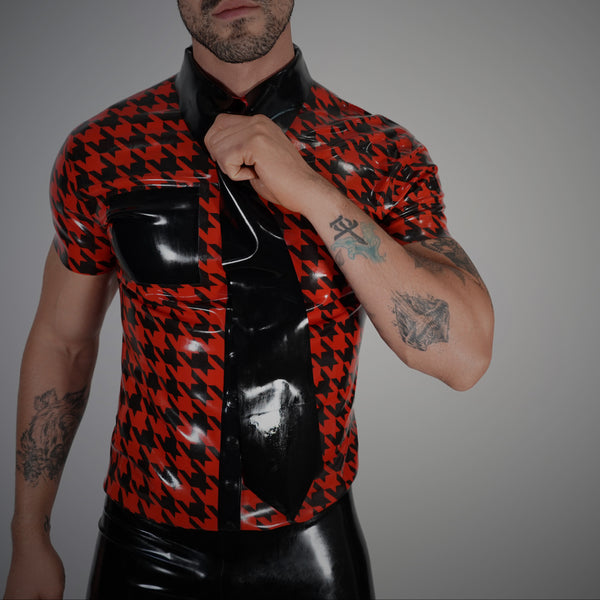
They all look bold from across the room. They wear, age, photograph, and cost completely differently. After 26 years cutting and gluing latex, I'll tell you exactly where each material wins — and where it doesn't.
Most "what's the difference" articles on this topic are written by people who've never made a garment from any of these materials. I have. So this guide cuts past the surface comparisons (shiny, sexy, bold) and gives you the real engineering, real care, and real cost reality of each.
Whether you're choosing between materials for a specific look, weighing a custom order, or just trying to understand why a latex catsuit costs ten times more than a PVC one, this is the comparison you actually need.
Latex wins on body-conforming silhouette, light play, photographing, color range, and longevity-per-dollar at the luxury tier. It's the only material of the three that behaves like a second skin.
Leather wins on structure, wear-anywhere casualness, and patina. It's the most forgiving to wear day-to-day. The most expensive entry to a quality piece, but lasts decades.
PVC wins on price and theatrical impact at distance. It's the right answer for costume, performance, and one-off events where you don't need a piece to last.
Natural rubber — tapped from the Hevea brasiliensis tree, processed into sheets, then either dipped (poured onto a form) or cut-and-glued (cut flat, hand-glued at the seams). At Vex, we work in cut-and-glued construction using 0.45mm latex sourced from England. It's a biological product. It has grain. Every sheet is slightly different.
Latex thicknesses run from 0.25mm (sheer, lingerie-weight) to 1.5mm (heavyweight, sculptural). 0.45mm is the luxury sweet spot — substantial enough to hold shape, thin enough to drape.
Polyvinyl chloride. A synthetic plastic, manufactured industrially, sold by the roll. Garments are heat-fused or machine-sewn. It mimics latex visually from a distance — high gloss, dark — but the material physics are different. PVC is stiffer, doesn't conform to the body, and has no give.
You'll also see it labeled "vinyl" or "PU coated." Quality varies wildly: fashion-grade PVC can hold up for a season, costume-grade can crack at the first wear.
Either genuine animal hide (cow most commonly, also lamb, calf, exotic) or synthetic PU "pleather." Genuine leather is sewn, edged, and finished by hand on quality pieces. The grade matters: full-grain leather is the strongest and ages best; corrected-grain and bonded leather are progressively cheaper and shorter-lived.
Pleather looks like leather and costs like fast fashion. It typically cracks within two years.
Moves with you. Stretches in every direction. Sits flush to the body — there's no daylight between fabric and skin. Catches light in concentrated highlights. Photographs unlike any other material because of its specular reflection.
Holds its own shape regardless of yours. Stiffer drape, less stretch, often visible creasing at flex points. Shines flatly without the variable luminosity of latex. Reads "costume" up close more often than "luxury."
Structured and opaque. Softens and molds to your body over months and years (genuine), creating a personal fit. Doesn't stretch — fit is built in by the pattern. Develops patina rather than wearing out.
| Care factor | Latex | PVC | Leather |
|---|---|---|---|
| Daily care | Polish with silicone-based shiner before wear; powder inside | Wipe with damp cloth | Wipe down; condition every 3–6 months |
| Washing | Mild soap and cool water, hang dry away from sunlight | Mild soap, wipe dry | Spot clean only; never submerge |
| Storage | Hang or fold flat in dark, cool space; talc to prevent sticking | Hang flat; avoid heat | Hang on padded hanger; avoid sunlight |
| Killers | Heat, sunlight, copper, oils, perfumes | Heat, sharp pressure, time | Water, sun, salt, hot dry environments |
| Lifespan w/ care | 20+ years | 2–5 years | Decades (full-grain); 1–3 years (pleather) |
Latex requires the most ritual but rewards it the most. There's a learning curve — first-time wearers should read our latex care guide before unboxing a custom piece — but once you have the routine, a Vex catsuit you bought in 2010 will still look like new in 2030.
The price comparisons people throw around are usually apples-to-oranges. Here's the honest range at each quality tier:
| Tier | Latex | PVC | Leather |
|---|---|---|---|
| Fast fashion | Not really available — even low-end latex starts around $200 | $30–$120 | $50–$200 (pleather) |
| Mid market | $300–$900 (ready-to-wear) | $120–$300 | $300–$1,200 (genuine leather) |
| Luxury custom | $2,500–$8,000+ (made-to-measure) | Rarely custom; $400–$800 | $2,000–$8,000+ (bespoke) |
For a fuller breakdown of where the money goes inside a latex garment, see why custom latex costs what it does.
If a brand advertises "vegan leather," check the material specification. Most "vegan leather" is plastic — PVC or polyurethane — with the environmental impact of plastic, not the longevity of real leather. Mushroom and cactus leathers exist but are rare and expensive.
Latex is the only one of these three materials that's a renewable biological product on a meaningful scale. It comes from a tree. It biodegrades. That doesn't make latex "eco-friendly" in every dimension — but it's worth knowing.
If you put a latex catsuit, a PVC catsuit, and a leather pantsuit on three women and walked them through a room, here's what would happen:
The latex would stop conversation. Its specular reflection means it carries highlights that move with the wearer — viewers notice it because their eye tracks the changing light. The PVC reads bold but flat; observers register it but don't linger. The leather reads expensive and confident but quiet — it doesn't demand attention the way the other two do.
None of these is better. They're different tools. A red-carpet moment usually wants latex. A power lunch wants leather. A nightclub appearance might want either latex or PVC depending on whether you're a headliner or a guest.
I've been making latex for 26 years. I've dressed Kim Kardashian, Niecy Nash, Bebe Rexha, Lady Gaga, Dita Von Teese, Marilyn Manson's touring company, and the cast of Bravo's Styled to Rock. I don't make leather, I don't make PVC. I make latex because I think it's the most extraordinary material a designer can work in.
If you've decided latex is the right answer for you, browse the full collection or start a custom commission. If you're not sure yet — read the rest of our material education library below.
Three Vex pieces that show what latex can do that leather and PVC can't:
Custom Vex pieces start at $2,500. Most commissions land between $5,000 and $8,000. Tell us what you have in mind and we'll quote, sketch, and build it from scratch.